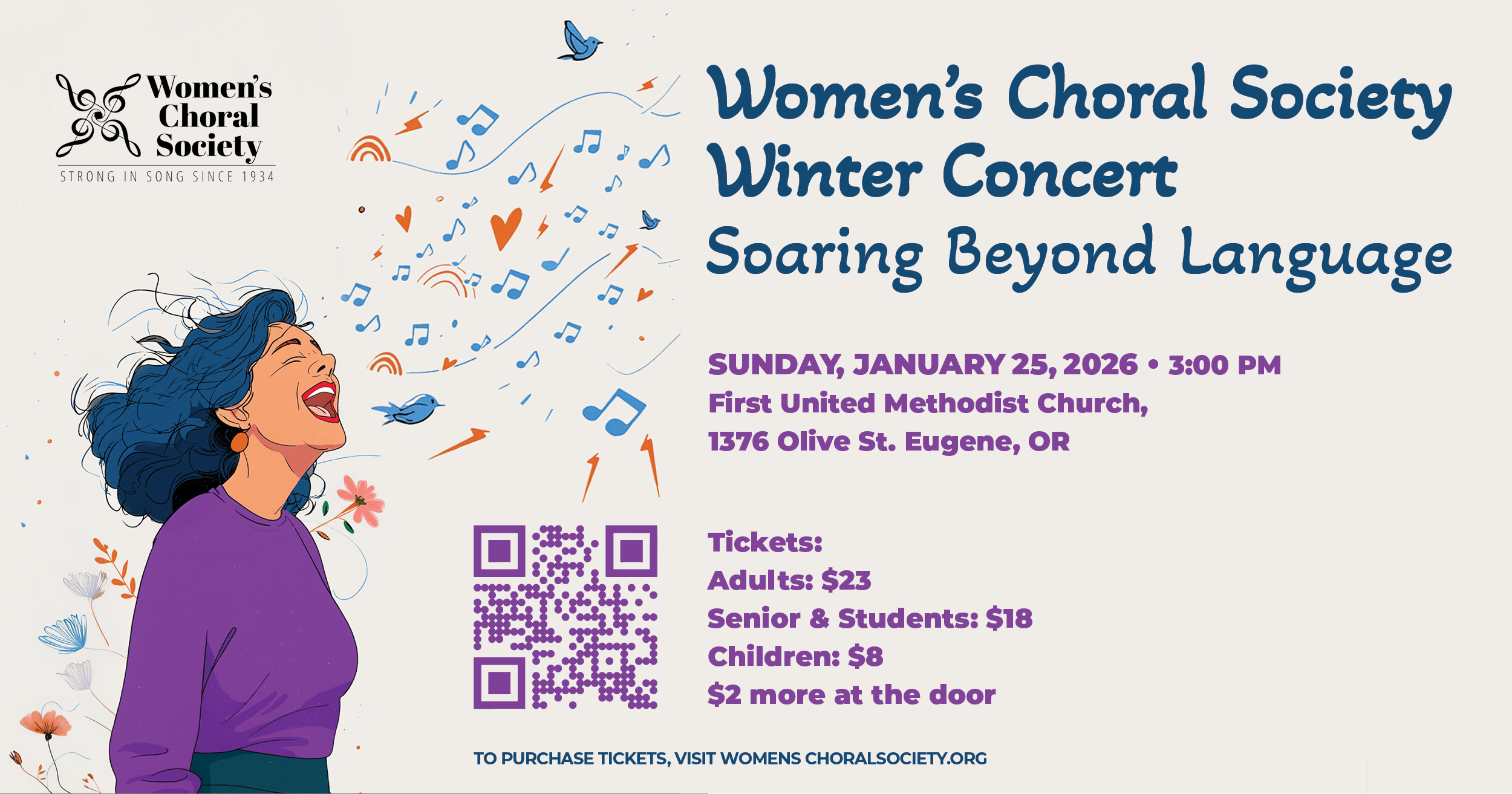
WCS Winter Concert
Sunday, January 25, 2026, 3:00 pm
First United Methodist Church
1376 Olive St.
Eugene, Oregon 97401
.png)
PROGRAM
Gloria by Vivaldi
Antonio Vivaldi (1678-1741) wrote this often-performed work, originally for female voices, when he was choirmaster and strings instructor at the Ospedale della Pietà, a girls’ orphanage in Venice, Italy, between 1713 and 1717. The Ospedale prided itself on the quality of its musical education and the excellence of its choir and orchestra. The orphan girls were trained solely in music and performed regular concerts, open to the public and hugely popular, as all-female orchestra, chorus, and conductors. The words for our selection of choruses from the “Gloria” are part of the Ordinary of the Mass, and date from approximately the 4th century.
Storm Comin’ by The Wailin’ Jennys
This is one of two pieces on the program with Canadian roots. Sung initially by the trio, The Wailin’ Jennys, who first started singing together in 2002, the lyrics speak to resilience. “When that storm comes, don’t run for cover. . . Don't run from the coming storm, 'cause you can't keep a storm from comin’”. Rather than feeling fear, “Will you listen to that thunder roar, and let your spirit soar.”
Flight by Craig Carnelia
American musical theater composer Craig Carnelia's songs have been recorded by a long list of artists as varied as John Lithgow and Sutton Foster. As a theater composer, he collaborated on the musicals WORKING and SWEET SMELL OF SUCCESS, and wrote the musical version of IS THERE LIFE AFTER HIGH SCHOOL? with playwright Jeffrey Kindley. Since 1992, he has been a teacher and mentor to young writers at workshops and various programs. Arranger Ryan Murphy is associate music director of The Tabernacle Choir and Orchestra. He previously conducted six choirs in the Boston area, including two at the prestigious New England Conservatory of Music Preparatory School. He holds a doctorate in choral conducting from Boston University. As you listen to the vivid lyrics and lush harmony you might just imagine yourself breaking free and soaring. Personal transformation and self-discovery await those who are willing to leave the mundane behind… or below. Close your eyes and fly away! How exactly does a song take flight? How do we take flight?
Vichten by Arthur and Angèle Arsenault
Composed in the 1900s in Prince Edward Island, Canada, this piece is a complete change of pace, literally and figuratively, from the rest of the concert. Inspired by traditional Acadian folk music and using sounds from the Mi’kmaq language, Vichten was written by Arthur Arsenault for his children and popularized by his daughter Angèle, an Acadian folk singer.
As is true with Adiemus, the lyrics, from the Mi’kmaq language, are sounds rather than words and as such form “mouth music” where voices sound like musical instruments. The joy and pace, and accompanying body percussion may make it difficult for you to remain in your seat. Enjoy!
Adiemus by Karl Jenkins
Welsh composer Karl Jenkins wrote Adiemus in 1994 as part of the Adiemus project, a set of albums of song-length pieces. “Adiemus” feels as though it is Celtic but as Jenkins once explained, “The text in Adiemus was written phonetically, with the words viewed as instrumental sound, the idea being to maximize the melisma (an expressive vocal phrase) by removing the distraction, if one can call it that, of words. The sound is universal, as is the language of music. If it resonates with you and feels familiar, you might be remembering the Delta airlines commercial and pre-departure videos from 1994 in which it was featured. The commercial is particularly well-done and worth Googling.
Hashivenu, Traditional, Arr. Michael Ryan:
“Hashivenu” is an essential prayer in the Jewish liturgy, found in Lamentations 5:21. The words translate into English as “Cause us to return to You, O Lord, and we shall be returned. Renew our days as you once did.” The prayer is a call to God for assistance in making Teshuvah, a Hebrew word that literally means "to return" and is often translated as “repentance.” It is a process of returning to a holier version of oneself and to a path of righteousness. The process of Teshuvah involves abandoning a sin, regretting the action, confessing it, making amends, and resolving not to repeat it in the future. “Hashivenu” is a plea for renewal, invoking hope and resilience. Michael Ryan’s poignant arrangement follows Jewish tradition of offering it as a round.